

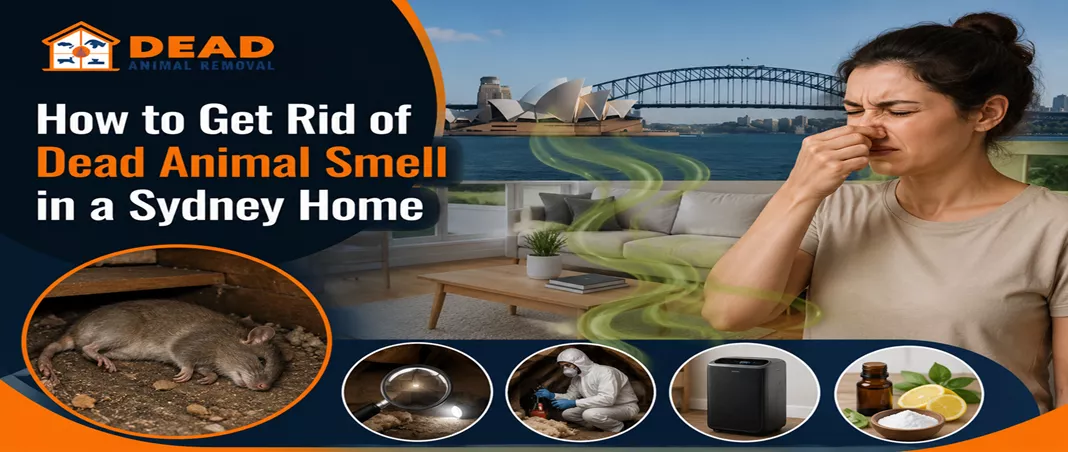
There’s a smell that squalitys you in your tracks the moment you walk through your front door. It’s not the bins. It’s not last night’s dinner. It’s something else entirely — thick, sweet, and wrong in a way that’s hard to put into words. If you’ve experienced it, you already know: a dead animal somewhere in your home is one of the most unpleasant situations a Sydney homeowner can face.
Knowing how to get rid of dead animal smell in your house isn’t just about comfort. Left untreated, decomposing animal odour can spread through your entire property within 24–48 hours, penetrate soft furnishings, and create real health risks from airborne bacteria and decomposition gases. In Sydney, where possums, rats, and native birds regularly find their way into roof cavities, wall voids, and subfloor spaces, this is far more common than most people realise.
In this guide, you’ll learn exactly what causes that smell, how to find the source when it’s hidden inside a wall or ceiling, which dead animal smell removal products actually work in Australian conditions, and when a DIY approach is no longer enough. Whether you’re dealing with a dead rat smell in a wall cavity, a decomposing possum in your roof, or an unidentified odour coming through your air conditioning vents, this article covers every step.
If you’ve already been searching for answers on how to locate a dead animal by smell alone — or you’re wondering how long the odour will last if you do nothing — you’re in the right place. For homeowners dealing with similar issues in other cities, finding a dead animal smell in your home follows the same core process regardless of location.
Let’s start with the science behind why this particular smell is so overwhelming — and why Sydney homes make it worse.
Why Dead Animal Smell Hits So Hard in Sydney Homes
That smell hits you the moment you open the front door. Sweet, thick, and unmistakably wrong — the odour of a decomposing animal inside your home is one of the worst things a Sydney homeowner can experience. And in this city’s climate, it gets bad fast.
Sydney’s warm, humid summers create near-perfect conditions for rapid decomposition. A dead possum, rat, or bird trapped in a wall cavity or roof space will begin producing noticeable odour within 24–48 hours of death. By day three to five, the smell becomes overwhelming — saturating insulation, timber framing, and plasterboard as gases and fluids spread outward from the carcass.
The science behind it is straightforward. Decomposing animal tissue releases a cocktail of volatile organic compounds — primarily putrescine and cadaverine — along with hydrogen sulphide and methane. These gases are porous-material magnets. They absorb into carpet, ceiling plaster, air conditioning ducts, and soft furnishings almost immediately, which is why simply removing the carcass often isn’t enough to eliminate the smell.
Sydney homes also have specific structural features that make this problem worse. Older Federation and Californian bungalow-style homes common across suburbs like Newtown, Leichhardt, and Marrickville have large accessible roof cavities and subfloor spaces — prime territory for possums, rats, and birds to enter, become trapped, and die. Once a carcass is in a confined, poorly ventilated space, odour has nowhere to go but inward through gaps in ceilings and walls.
Understanding why the smell is so persistent is the first step toward eliminating it properly — not just masking it with air freshener and hoping for the professional.
 Sydney’s Seasonal Dead Animal Incident Calendar
Sydney’s climate doesn’t just affect your garden — it directly determines when and where animals are most likely to die inside your home. Knowing the seasonal patterns helps you act faster when that first wave of decomposing animal smell hits.
| Season | Most Common Animal | Typical Location | Odour Intensity |
|---|---|---|---|
| Summer (Dec–Feb) | Rats, mice, possums | Roof cavity, wall voids | 🔴 Extreme — heat accelerates decomposition rapidly |
| Autumn (Mar–May) | Possums, birds | Ceiling, under house | 🟠 High — animals seek shelter as temperatures drop |
| Winter (Jun–Aug) | Rats, mice | Wall cavities, insulation | 🟡 Moderate — cooler temps slow but don’t squality odour |
| Spring (Sep–Nov) | Rats, birds, snakes | Subfloor, roof, vents | 🟠 High — breeding season increases animal activity indoors |
Summer is the danger season for Sydney homes. When roof cavity temperatures exceed 50°C during western Sydney heatwaves, animals that entered seeking cool air can quickly become trapped and die. A dead possum in a roof cavity during January will reach peak odour within 24–48 hours — compared to 3–5 days in winter conditions.
Spring brings a different problem. Increased rodent and bird activity means more animals entering homes through damaged eaves, broken vents, and gaps around pipes. Suburbs like Penrith, Blacktown, and the Hills District — where homes back onto bushland — see a sharp rise in dead animal under house smell complaints between September and November as animal species pushes into residential areas during breeding season.
Pro Tip: If you’ve recently had a pest control treatment for rats or mice, mark your calendar for 5–10 days later. That’s the window when poisoned rodents typically die inside wall cavities — and when the dead rat smell in walls peaks. Plan ahead rather than waiting to be hit by the odour.
How to Find a Dead Animal Hidden in Your Walls, Ceiling, or Under the House
The smell is obvious. The source isn’t. Finding a hidden carcass in a Sydney home takes a methodical approach — because the odour rarely comes from directly above or below where you’re standing. Air currents, insulation, and cavity layouts all push the smell in unexpected directions.
Follow Your Nose — But Don’t Trust It Completely
Start by moving through the house slowly with all windows closed for at least 30 minutes first. The smell will be strongest closest to the carcass, but wall cavities and roof spaces can funnel odour several metres away from the actual location. Get low to the ground when checking under-floor areas, and use a torch to scan along wall bases, behind insulation batts, and around pipe penetrations where animals commonly squeeze through.
Common hiding spots in Sydney homes include:
- Roof cavity near the ridge: Possums and rats often die near entry points or in corners where insulation is thickest
- Wall cavities behind kitchen or bathroom: Rats follow pipe runs and frequently die near warm areas
- Under the subfloor near the perimeter: Possums and bandicoots enter through broken vents and die close to entry points
- Inside air conditioning ducts: Small rodents enter duct systems and die inside — the smell then circulates through every room
What to Look For Visually
If you can access the roof cavity or subfloor, look for dark staining on timber, disturbed insulation, or fly activity — blowflies will cluster directly above or below a carcass within 24–48 hours of death. In wall cavities where you can’t see, press your hand flat against the plasterboard. A warm patch combined with the odour often indicates the carcass is directly behind that section of wall.
Pro Tip: If you suspect a dead animal inside a wall but can’t locate it, try removing the nearest power outlet cover plate (with power off at the switchboard). The gap around the cable is often enough to confirm the smell source — and gives a pest technician a precise starting point without unnecessary wall damage.
For homes in Sydney’s older suburbs like Leichhardt, Balmain, or Glebe, original timber framing with gaps and unsealed cavities makes it significantly harder to pinpoint location. A professional using thermal imaging or borescope cameras can locate a carcass in under 20 minutes — work that might take a homeowner hours of guesswork.
Dead Animal in HVAC Ducts: A Sydney-Specific Problem
Sydney homes have a particular vulnerability that most other cities don’t deal with at the same scale: ducted air conditioning systems. Rats, mice, and possums regularly enter roof cavities and wall spaces — and HVAC ductwork is one of their favourite travel routes. When an animal dies inside a duct, the smell doesn’t just sit in one room. Your air conditioning system pumps decomposing animal odour through every vent in the house.
Why HVAC Systems Make the Smell Worse
A dead animal in a wall cavity smells bad. A dead animal in your ducting smells everywhere, all at once. Every time the system runs, warm air passes over the carcass and carries volatile organic compounds — the gases released during decomposition — directly into your living spaces. In Sydney’s hot summers, when air conditioning runs almost constantly, this cycle repeats dozens of times a day.
The smell also gets absorbed into the duct lining itself. Even after the carcass is removed, contaminated ductwork can continue releasing odour for weeks unless the affected section is sanitised or replaced.
Pro Tip: If the smell intensifies when your air conditioning turns on, that’s a near-certain sign the carcass is inside the ductwork — not just nearby. Turn the system off immediately and avoid running it until the animal is removed. Continued use spreads bacteria and odour compounds through your entire home.
What to Do If You Suspect a Dead Animal in Your Ducts
- Switch off the HVAC system — squality circulating contaminated air through the property.
- Check accessible vent covers — remove grilles and use a torch to inspect the nearest duct sections for signs of nesting or remains.
- Call a skilled technician — duct access in Sydney homes often requires roof cavity entry and focused resource. This isn’t a DIY job.
- Request duct sanitisation — removal alone isn’t enough. The affected duct section needs to be treated with an enzyme-based sanitiser to eliminate residual odour and bacteria.
NSW Possum Laws Every Sydney Homeowner Must Know
Here’s something that catches a lot of Sydney homeowners off guard: possums are protected under the NSW Biodiversity Conservation Act 2016. That means you cannot properly trap, relocate, or dispose of a possum — dead or alive — without following strict rules. Get it wrong and you’re looking at serious fines.
What the Law Actually Requires
If you find a dead possum in your roof cavity or under your house, you can’t simply bag it and bin it. Dead possums must be handled and disposed of in line with NSW Environment Protection Authority guidelines. For live possums, only skilled handlers can relocate them — and only within 50 metres of the capture site, meaning you can’t just dump them in a nearby park.
What This Means for Dead Possum Smell Removal
If a possum has died in your roof or wall cavity, the proper and safest path is to call a pest controller or removal expert. They carry the appropriate permits to handle carcass removal, treat the affected area for secondary pest infestations (blowflies and maggots follow fast), and apply professional-grade odour treatment.
Pro Tip: Don’t wait on a dead possum smell hoping it’ll fade. A brushtail possum can weigh up to 4kg — that’s a significant decomposing mass in a confined roof space. The smell peaks around days 3–5 and can linger for weeks without proper carcass removal and sanitisation.
For Sydney homeowners, the practical takeaway is simple: dead possum removal in Sydney is not a DIY job — properly or practically. A technician handles the carcass correctly, protects you from fines, and gets the odour source eliminated properly the first time.
How to Dispose of a Dead Possum or Rat Properly in Sydney
Once you’ve located and bagged the carcass, disposal isn’t as simple as tossing it in the bin. Sydney residents need to follow specific guidelines — and with possums, there are proper obligations that catch many homeowners off guard.
Is It Proper to Remove a Dead Possum Yourself?
Common brushtail and ringtail possums are protected animal species under the NSW Biodiversity Conservation Act 2016. If a possum dies on your property, you’re allowed to remove and dispose of the carcass — but you cannot kill, trap, or relocate a live possum without a from the NSW Environment Protection Authority (EPA). Handling a dead possum doesn’t require a permit, but improper disposal can still attract council fines.
How to Dispose of the Carcass Properly
- Double-bag it: Place the carcass in two sealed plastic bags before disposal to contain odour and bacteria.
- General waste bin: Small animals like rats, mice, and birds can go into your regular household waste bin on collection day.
- Council waste facility: For larger animals — possums, cats, or rabbits — take the sealed bag to your local NSW council waste facility or contact your council for a bulk waste collection.
- Don’t bury it on your property: Burying carcasses in residential areas is discouraged in most Sydney council zones and can contaminate soil and groundwater.
Pro Tip: Call your local Sydney council before disposal if the animal is larger than a rat. Councils like Georges River, Bayside, and Inner West each have slightly different bulk waste and animal disposal procedures — a 2-minute call saves a potential fine.
What About Dead Rats After Rodenticide Treatment?
If a pest control technician used rodenticide bait, secondary poisoning is a real risk. Don’t let pets near the carcass, and wear gloves when handling. Dispose of it the same day you find it — don’t leave it in the bin overnight in warm weather, as decomposition accelerates quickly in Sydney’s humidity and the smell will return fast.
Step-by-Step: How to Remove Dead Animal Smell from Your Home
Once you’ve located and removed the carcass, the smell doesn’t just disappear. Decomposition fluids soak into timber, insulation, and plasterboard — and those surfaces need direct treatment. Here’s exactly what to do, in order.
Step 1: Remove the Carcass First
Nothing else works until the source is gone. Wear heavy-duty gloves and a P2 respirator mask. Double-bag the carcass in thick plastic bags, seal tightly, and dispose of it in your general waste bin — not recycling. In Sydney, this is suitable with NSW local council waste disposal guidelines.
Step 2: Clean the Contaminated Area
Apply an enzyme-based cleaner directly to the affected surface. Enzyme cleaners break down the proteins in decomposition fluid — standard disinfectants don’t. Products like BioZyme or similar Australian-stocked enzyme cleaners work well. Soak the area, leave for 10–15 minutes, then wipe clean. Repeat if the staining is heavy.
Step 3: Treat the Air
Open windows and run fans to push stale air out. Place activated charcoal bags or bowls of white vinegar near the affected area — both absorb airborne odour molecules rather than masking them. Avoid aerosol air fresheners; they layer a synthetic scent over the decomposition smell and make it worse once the spray fades.
Step 4: Check Your Air Vents and Insulation
If the animal was in a roof cavity or wall, odour travels through your ducted air conditioning system. Remove and inspect vent covers. If you see staining or smell the odour directly from the duct, the insulation inside may need replacing. This is a job for a professional — contaminated insulation can’t be cleaned, only removed.
Pro Tip: Soft furnishings like curtains and upholstered furniture absorb decomposition odour quickly. If rooms near the carcass location smell musty even after cleaning.
Step 5: Neutralise Residual Smell in Walls or Floors
For dead rat smell in walls or odour coming up through floorboards, a diluted bleach solution (1 part bleach to 10 parts water) applied to accessible timber surfaces helps kill bacteria driving the smell. For enclosed wall cavities, an odour-neutralising fogger designed for biohazard use is more effective than surface sprays alone.
Odour Elimination Products Available in Australia: Comparison Table
Not all odour products work the same way. Some mask the smell temporarily. Others break down the organic compounds causing it. For dead animal odour, you need products that neutralise or digest the source — not just cover it up with fragrance. Here’s how the main options available in Australia compare.
| Product Type | Example (AU Available) | How It Works | Effectiveness on Dead Animal Smell | Avg Cost (AUD) | Professional For |
|---|---|---|---|---|---|
| Enzyme Cleaner | Biozet, Urine Off, BioAmp | Breaks down organic matter at a molecular level | ✅ High — targets the source directly | A$15–A$45 | Accessible surfaces, subfloor areas |
| Activated Charcoal | Odour Absorb, generic bags | Absorbs airborne odour particles passively | ⚠️ Moderate — helps after source is removed | A$10–A$30 | Enclosed spaces, roof cavities, cupboards |
| Odour Bomb / Fogger | Nilodor, Ozium | Disperses neutralising agents through air | ⚠️ Moderate — temporary if source remains | A$20–A$60 | Whole-room treatment post-removal |
| Air Purifier (HEPA + Carbon) | Dyson, Winix, Breville | Filters particulates and VOCs from circulating air | ✅ High — ongoing air quality improvement | A$150–A$600+ | Homes with lingering smell after removal |
| Baking Soda / Vinegar (DIY) | Pantry staples | Mild acid/base neutralisation | ❌ Low — surface-level only | Under A$5 | Very mild odours, not decomposition smells |
| Professional Biozyme Treatment | Applied by skilled technicians | Industrial-grade enzyme + disinfectant application | ✅ Very High — full decontamination | A$150–A$400+ | Severe infestations, wall cavities, roof spaces |
Prices correct as of mid-2025. Costs vary by retailer and job complexity.
Pro Tip: Enzyme cleaners are your professional first move for any accessible contamination area. But if the carcass was inside a wall or ceiling cavity, no retail product will fully reach the source. That’s when a professional dead animal removal service with industrial biozyme treatment becomes the only reliable fix.
How to Get Dead Animal Smell Out of Walls and Insulation
Walls and insulation are the hardest places to deal with — and the most commonly overlooked. When a rat or possum dies inside a wall cavity, the smell gets trapped and amplified. The odour seeps through plasterboard, travels along insulation batts, and can spread across an entire room before you even know where it’s coming from.
Why Walls Make the Smell Worse
Insulation materials — particularly fibreglass batts and polyester fill — absorb decomposition fluids and hold onto the smell long after the carcass dries out. Standard surface sprays won’t reach the source. Even if you apply odour neutralisers to the wall surface, the contaminated insulation behind it keeps releasing odour for weeks.
In older Sydney homes with timber framing and original plasterboard, the problem is worse. Decomposition liquids can soak into the timber studs themselves, creating a secondary odour source that’s nearly impossible to treat without physical access.
What Actually Works
- Locate before you treat. There’s no point spraying anything until you know exactly where the carcass is. Use the smell gradient — move along the wall and find the spot where the odour peaks. That’s your access point.
- Cut access, remove the carcass, replace insulation. If the animal is inside the wall, a section of plasterboard usually needs to come out. The contaminated insulation batt must be bagged and disposed of — it cannot be cleaned in place.
- Treat the cavity with enzyme cleaner. Once the carcass and insulation are removed, spray an enzyme-based cleaner (available at Bunnings or Woolworths) directly into the wall cavity before patching. This breaks down residual proteins causing the odour.
- Ventilate the cavity. Leave the access point open for 24–48 hours if possible before patching. Airflow dramatically accelerates drying and odour dissipation.
Pro Tip: Don’t patch the wall the same day you remove the carcass. Sealing a damp, contaminated cavity locks the smell in. Wait at least 48 hours after enzyme treatment and airflow before closing it up.
If you’re not comfortable cutting into walls yourself, a dead animal removal technician in Sydney can locate, extract, and treat the cavity — then arrange a plasterer to patch it. For complex infestations where multiple animals may be involved, reviewing effective pest control methods for preventing future entry is a smart next step once the immediate problem is resolved.
Conclusion
Dead animal smell in a Sydney home is unpleasant, but it’s also a health risk and a property issue that gets worse the longer you leave it. The odour doesn’t just fade on its own — it lingers for weeks without proper removal and decontamination.
- Ventilate first, then locate: Fresh air and a systematic search are your starting points before any treatment begins.
- DIY works for accessible carcasses: If you can reach the animal safely, removal plus an enzyme cleaner and odour absorber will handle most cases.
- Hidden carcasses need professionals: Inside walls, under floors, or in roof cavities require skilled technicians with the right resources and safety gear.
- Decontamination matters as much as removal: Skipping sanitation after removal leaves behind bacteria, fly larvae, and residual odour that can last for months.
- Prevention squalitys repeat problems: Sealing entry points after removal is the only way to avoid the same situation next summer.
Sydney’s warm climate means decomposition happens fast — faster than in cooler states. A carcass that’s been sitting for more than 48 hours in a roof cavity during a January heatwave is a serious job. If you’re not confident handling it yourself, a dead animal removal service will have the property smelling normal again within 24 hours, with full sanitation included.